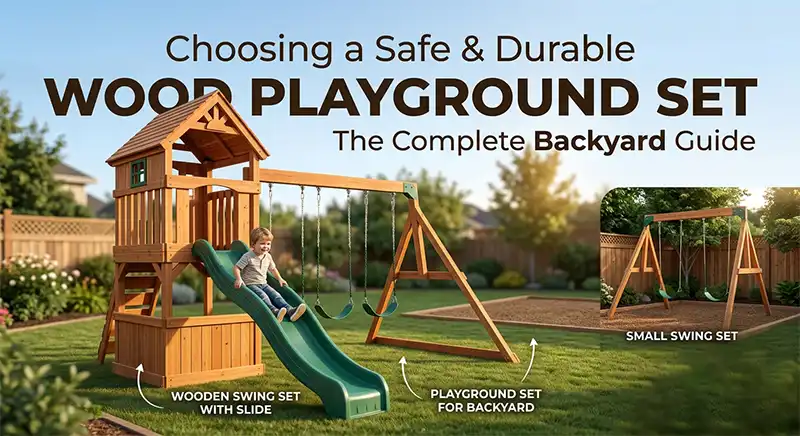
Whether you are planning a wood playground set layout in your own backyard or making a living by investing in building materials, when choosing wooden play equipment, you often encounter the same issues: selecting the wrong wood, hardware that is too fragile, and unmeasured safety zones. So, what exactly is wooden play equipment? How should you choose and buy it? First, let us tell you that PAFIC PLAY has nearly 30 years of production experience. As for what materials are safe and reliable and how to choose them, we will answer for you using our experience.
So, what exactly is wooden play equipment?
Simply put, wooden play equipment is a wooden frame—usually a tower or an A-frame—with swings, slides, ladders, and maybe a climbing wall attached on top. The wood is the skeleton, and everything else attaches to it. If the frame is made well, the rest is just details. If the frame is made wrong, even the best accessories cannot save you.
In our factory, a set of products goes through various processes such as laser cutting, robotic welding, woodworking, molding, and powder coating. Only after ensuring product safety through various tests can we feel confident delivering it to customers for inspection and packing. What you buy is actually the sum of all these processes, not just the smiling child on the packaging box.
Wood, Metal, or Vinyl? (The Question Everyone Asks)
Buyers often ask us: “Metal is stronger, so why use wood?” Good question. Here is an honest answer from a craftsman who makes all three materials:
Wood:
It looks warmer, stays cooler in the sun, and is better suited for a backyard. What is the downside? If you pick the wrong wood, you will face risks like damp wood and small bugs, which pose dangers to children’s safety. We use moisture-resistant and insect-resistant cedar, which undergoes anti-corrosion treatment and has rounded edges to ensure safety during use and achieve a longer service life.
Metal:
It feels indestructible, and in most cases, it indeed is. However, under direct sunlight, metal oxidizes quickly, and once the coating peels off, it will rust.
Vinyl-wrapped wood:
Low maintenance cost, higher price, and you cannot see the wood underneath. If the seams crack, there is a hidden safety hazard.
For most backyards, a properly treated Wooden Swing Set with Slide is still better in terms of appearance and feel.
Choosing a Wooden Swing Set with Slide
A Wooden Swing Set with Slide is the configuration we are asked about the most—it is also the ideal swing set in many families’ minds. The following three layouts basically meet your needs:
Classic Swing Set:
Belt swings or bucket swings on an A-frame, plus a slide tower. It has the lowest shipping cost and the easiest installation. A smart choice. You can check out this set of ours—it is suitable as a Small Swing Set for smaller backyards without taking up space, and it is fully functional to give kids a different experience.
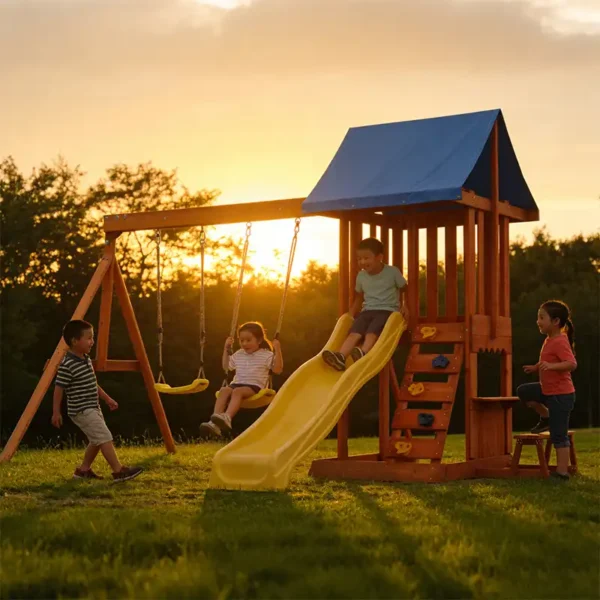
Play Tower with Canopy:
A play tower with a sunshade canopy, equipped with a swing beam, slide, and climbing wall. It offers a larger play space per unit area.
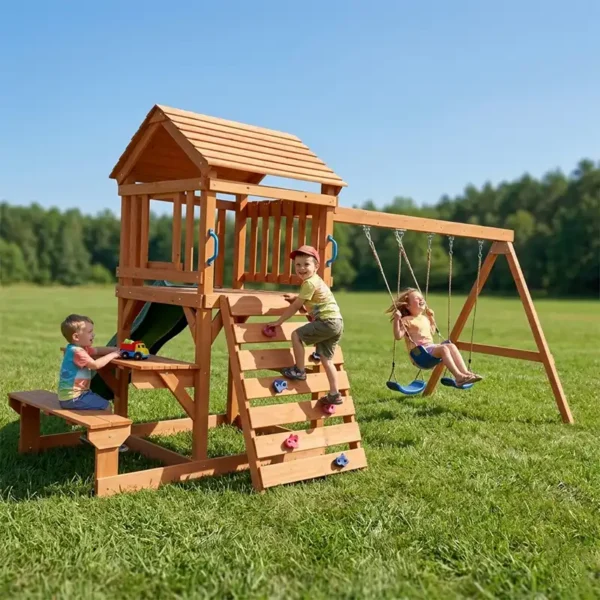
Clubhouse Play Set:
A roofed playhouse, ladder, swings, and wave slide. It has the strongest interactivity and the largest footprint—kids have a blast playing with it.
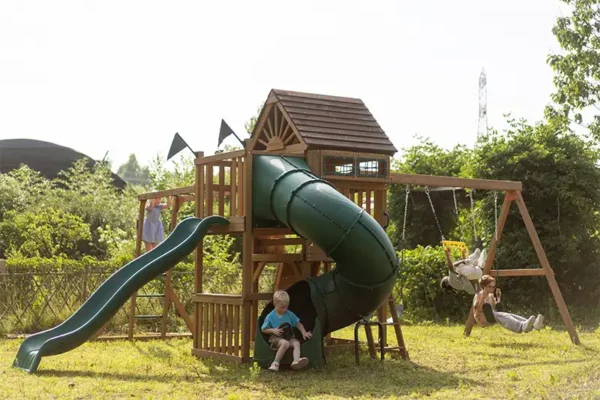
One thing people often overlook:
the slide. For young children, a wave slide (a gentle S-curve) is safer than a straight slide, and the slide surface should use UV-resistant plastic so that it won’t turn white after one summer.
How to Choose the Right Playground Set for Backyard
Whether a Playground Set for Backyard will be successful depends on two key factors: usable space and the safety zone. The footprint of the play equipment is only half the story. You need to set a buffer area of about 6 feet (around 1.8 meters) around each swing and platform. The arc area of the swings takes up much more space than the play tower itself—trust me, we have measured many backyards filled with regret.
Before you fall in love with a Wood Playground Set, please do this first:
Measure the area of the flat region, then subtract a 6-foot buffer area on all four sides.
Choose ground surfacing: rubber mulch, engineered wood fiber, or lawn (lawn alone usually does not meet safety standards and cannot withstand falls above about 1.5 feet).
Check above—make sure there are no power lines, low tree branches, or eaves in the swing path.
Select appropriate ground anchors (concrete bases or spiral anchors) according to soil conditions.
What Really Determines the Service Life
A wooden swing frame has two Achilles’ heels: moisture seeping into the end grain of the wood, and bracket bending deformation. Here are the specifications of our own product line:
Wood: Cedar wood is naturally rot-resistant; moisture-resistant and insect-resistant. No matter which wood is used, exposed end grain needs to be capped. Gaskets can prevent water from seeping in.
Hardware: Stainless steel or triple-coated screws—do not use screws that peel after 18 months. Brackets should be reinforced with gussets rather than flat plates.
Anchors: Use spiral anchors for soft soil, and concrete anchors for towers over 6 feet. A set of play equipment that could tip over at any time cannot just let children play on it casually; safety is the most important.
We have seen some “cost-cutting” play equipment that used bare screws instead of coated screws just to save a few cents per set. As a result, they were returned due to warranty issues in less than a season.
We hold ISO 9001, BSCI, Sedex, and Walmart certifications, and our products comply with ASTM F963, EN 71, and AS/NZS 8124 standards. It is precisely these certification documents that enable us to serve more than 30 partners across the US, Europe, Australia, the Middle East, and Latin America.
One More Point—For Procurement Buyers
If you are a procurement buyer, everything above is your quality control checklist. When purchasing in bulk, the partner is more important than the product catalog photos. We provide the following services for OEM and ODM customers:
Customize colors, sizes, and layouts according to your market needs.
Your logo, brand identity, and retail-ready packaging, along with flexible minimum order quantities.
Full-process control from CAD design and sample making to quality control and container shipping.
Our process is: Requirement Confirmation → Design Plan → Sample Production → Design Optimization → Production → Logistics. We have a 50,000-square-meter factory, so we are able to control delivery time and product quality. For more information, please visit our OEM/ODM service page or read our company introduction.