
Whether you are taking a walk through a residential neighborhood on a sunny afternoon or browsing the best-selling outdoor play products on retail shelves, you will notice a clear trend: the traditional single-plank swing is no longer the only favorite. The saucer swing (also commonly called a web swing or nest swing) has quickly become a popular choice for backyards, community play areas, and commercial product catalogs.
Whether you are a distributor, a private-label brand, or a manufacturer, you have probably realized that growing consumer demand also brings a series of practical manufacturing questions: What fabric can withstand constant summer sun without tearing? How do you prevent the hanging ropes from wearing out near the adjustment buckles? And what really separates a cheap seasonal import from a durable, certified product that protects your brand’s reputation?
Since our founding in 1997, PAFIC PLAY has spent nearly 30 years on the production floor. In our 50,000 m² manufacturing facility, we test steel tubing, sew industrial-grade textiles, and run mechanical load cycle tests every day. In this guide, we will go through the key factors to consider when sourcing and manufacturing a commercial-grade saucer swing.
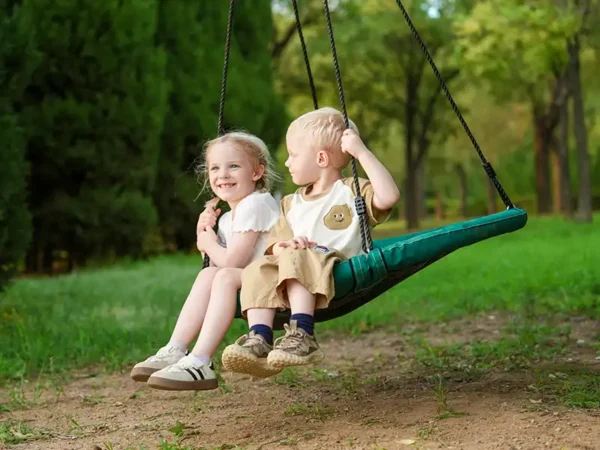
1. Fabric Selection: 900D Oxford vs. Textilene vs. Webbing/Rope Net
The center seat mat takes the most direct exposure to weather and weight load. When choosing the fabric, there are usually three main options:
- 900D Oxford Fabric with PU Coating: This is our first recommendation for durable consumer-grade and commercial-grade swings. Compared with cheap 600D fabric, which becomes thin after one season, high-density 900D polyester offers better tensile strength and puncture resistance. We apply UV-resistant and water-repellent coatings to keep the colors bright and prevent mildew.
- Textilene Mesh: A mesh fabric tightly woven from PVC-coated polyester yarn. It drains water and breathes very well, which makes it a good fit for rainy or humid climates and helps avoid water pooling.
- PE Webbing/Rope Net (Spider Web Swing): Made of heavy-duty braided polyethylene (PE) ropes woven across the frame. Although this “spider web” style is very popular, the weaving tension must be set accurately so that young children’s hands and feet do not get caught between the ropes.
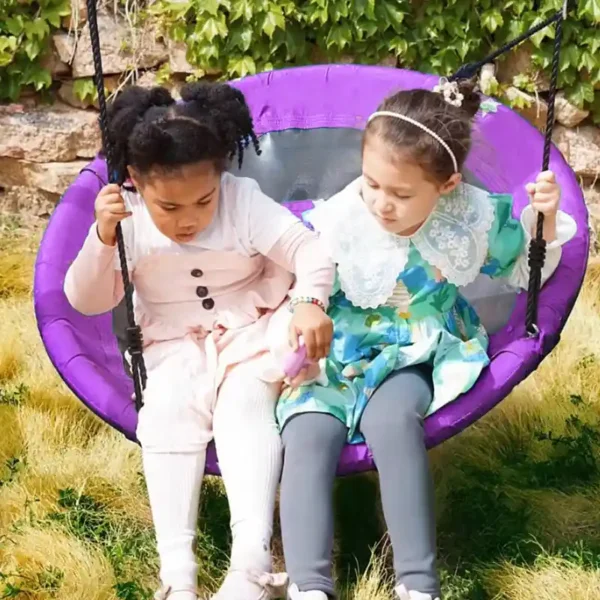
2. Frame Structure and Protective Padding
The diameter of a standard saucer swing is usually 36 inches (90 cm) for toddler models, and 40 inches (100 cm) or 48 inches (120 cm) for multi-rider models. The frame under the fabric directly determines the safety of the user.
Steel Tubing Specifications
We use high-spec steel tubing processed with precision CNC bending. The tube diameter is usually between 25 mm and 32 mm, with a wall thickness of at least 1.2 mm to 1.5 mm. To prevent internal rust caused by condensation, all steel parts are hot-dip galvanized or electrostatically powder coated.
Foam Padding
Children will inevitably lean on or bump into the outer rim while playing. We wrap the steel parts in high-density EPE foam or high-resilience EVA padding, and seal this foam layer inside a strong, durable fabric sleeve. The padding must last, keeping its shape over years of use without cracking from temperature changes.
3. Hanging Ropes and Hardware: The Key to Safety
Even if the frame is extremely strong, the whole product fails once the hanging parts fail. The hanging parts must be made to strict engineering tolerance standards:
- Multi-Strand Braided PE Ropes: We use multi-strand braided polyethylene (PE) ropes with a diameter of 10 mm to 12 mm. Compared with harder polypropylene (PP) ropes, PE feels softer and is gentle on children’s hands, while also offering good resistance to UV aging and wear.
- Adjustment Buckles and Rings: We use galvanized figure-8 carbon steel adjustment buckles, which allow smooth height adjustment (from 40 to 70 inches) and lock firmly under load.
- Tree Straps and Swivel Hooks: When the swing is hung from an outdoor tree branch or a freestanding stand, 360-degree ball-bearing swivel connectors keep the ropes from twisting and reduce cyclic shear stress.
4. Weight Limits: Static Testing vs. Dynamic Testing
When you see a retail package that says “weight capacity: 700 lbs (317 kg)” or “800 lbs,” what does that actually mean in the testing lab?
Placing a static weight on a swing that is not moving is very different from running a dynamic drop test on the same product. Following ASTM F1148 (the North American standard for home playground equipment) and EN 71 (the European toy safety standard), we carry out the following tests:
- Static Overload Test: A load of 2.5 to 3 times the rated capacity is applied and held for a period of time to make sure there are no weld cracks or joint deformation.
- Dynamic Impact and Drop Test: Calibrated weights are dropped repeatedly onto the center and edges of the seat mat to simulate several children playing hard at the same time.
- Salt Spray Corrosion Test: The surface coating of the hardware is tested in a salt spray chamber for 48 to 96 hours to make sure it resists rust and holds up well in outdoor environments.
5. OEM/ODM Customization Services from PAFIC PLAY
If you are developing your own brand product line, standard off-the-shelf products often cannot give you enough profit margin or enough difference to win in the market. As an experienced OEM/ODM manufacturer with nearly 30 years of engineering experience, our 50,000 m² factory supports full custom development:
- Custom Logo: High-resolution brand patterns. You can choose how your logo is applied based on your requirements.
- Fabric and Size Options: We offer different size specifications and can customize the size to your needs. We also offer swings in different shapes, such as round, oval, and hexagonal.
- Retail-Ready Packaging: Compact color box design, clear multi-language instructions, and blister-packed hardware designed to make assembly easy for end consumers.
- Strict Compliance Standards: We meet the requirements of the ISO 9001 quality management system and BSCI social compliance audits.
Frequently Asked Questions (FAQ)
What is the recommended minimum age for a saucer swing?
Most 40-inch saucer swings are suitable for children aged 3 and older. For toddlers under 3, we recommend a fully enclosed high-back bucket swing to give the body proper support.
How is a saucer swing different from a traditional belt swing?
A traditional belt swing is usually for one rider swinging back and forth. A saucer swing lets several children sit, lie down, or stand on it at the same time, which encourages group play and also has a calming sensory effect.
Can a saucer swing be left outside in winter?
Although UV-treated 900D Oxford fabric and galvanized steel hardware can handle low temperatures, bringing the fabric seat indoors during long periods of snow or freezing rain will extend the product’s service life and keep the fabric at its best tension.
Ready to develop or upgrade your outdoor swing product line? Contact the PAFIC PLAY engineering team to discuss product specifications, sample making, and container order pricing.