_result-1779951619.webp)
When planning a backyard playground set for children, striking a balance between fun, spatial layout, and safety is key to a successful playground setup. How can you transform an ordinary yard into a vibrant wooden playset for kids? It requires both safety and a well-planned spatial layout. Introducing large wooden structures necessitates careful space planning and adherence to safety standards.
Here’s a practical guide on how to assess your backyard space, properly place backyard playset, and meet essential safety requirements.
First, measure your yard: Calculate the total footprint and safety zone.
A common mistake when purchasing wooden swing set is measuring only the base frame. While the physical footprint of a platform and posts may be 10 x 12 feet, the actual space you’ll need in your yard is much larger.
6-Foot Clearance
Safety guidelines, including ASTM (American Society for Testing and Materials) and EN71 standards, recommend maintaining a safety zone of at least 6 feet (1.8 meters) around the entire perimeter of the playground equipment. This buffer zone ensures children have ample space to come down the slide and run and play around the area without bumping into fences, trees, garage walls, or hardscape elements.
Swing Clearance
Due to the movement trajectory of a swing, it requires more space than the standard 6-foot (approximately 1.8-meter) rule. To calculate swing clearance, measure the height of the swing beam from the ground, multiply that height by 2, and extend that distance to both sides of the swing seat. For example, if your swing beam is 8 feet (approximately 2.4 meters) high, you need 16 feet (approximately 4.9 meters) of unobstructed space in front of and behind the swing.
Ground Preparation and Fall Protection
No matter how sturdy the wooden structure, the ground beneath the playground equipment plays a crucial role in preventing injuries. Hard surfaces such as concrete, asphalt, compacted soil, or natural grass do not provide sufficient impact absorption.
Engineered Wood Fiber (EWF): Requires a thickness of 9 to 12 inches (approximately 23 to 30 cm). It offers excellent shock absorption and a natural look, but requires occasional raking.
Pea Gravel or Sand: Requires a thickness of 9 to 12 inches. This is an affordable and easy-to-lay option, but it may shift over time and requires fencing.
Rubber Mulch or Mat: Requires a thickness of 4 to 6 inches. This option offers high durability, low maintenance costs, and excellent impact protection.
Over time, loose fill can compact due to foot traffic and weather conditions. Fencing around the play area helps secure loose material and maintain an appropriate protective thickness.
Different Backyard Layout Recommendations
For Compact or Narrow Yards:
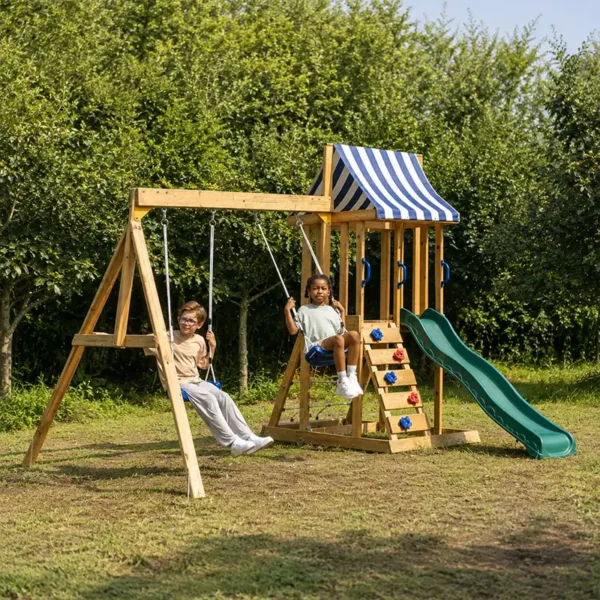
Choose a Vertical Structure: Opt for a play area design that utilizes vertical space, such as a two-story clubhouse with slides or climbing walls built directly into the frame. This saves space.
Linear Layout: Look for a compact design where the swing beams run parallel to the main play tower, rather than extending laterally into the yard.
Suitable for Spacious Patios:
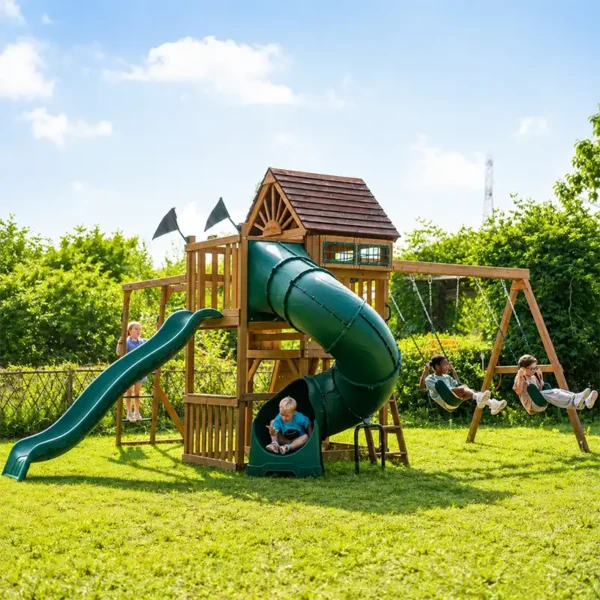
Zoning: Place the play equipment away from areas where adults frequently gather (such as outdoor dining patios or fire pits), while ensuring it is clearly visible from kitchen windows or patio seating. This allows parents to monitor their children’s activities and ensure safety.
Security: Ensure the play equipment is securely anchored to a level surface. If your yard has a slope greater than 3 to 5 degrees, level the ground before installation. Do not rely on uneven posts to avoid compromising structural integrity over time.
Structural Integrity: Factors to Consider for Timber Frame Structures
Besides size, safety also depends on physical stability and material workmanship:
Post Size: Solid wood posts of 4×4 or 4×6 inches provide maximum stability and prevent swaying when multiple children are playing simultaneously.
Hardware and Grooves: Choose heavy-duty galvanized or stainless steel hardware. Bolts should be countersunk or covered with protective plastic caps to prevent snagging on clothing.
Smooth surfaces and rounded corners: Wooden components should have smooth, planed surfaces and rounded corners (bevels) to minimize splinter and impact injuries.
Taking the time to accurately measure your space and choose a design that meets recognized safety distances will ensure your backyard playground set remains a safe and enjoyable recreational area for years to come.