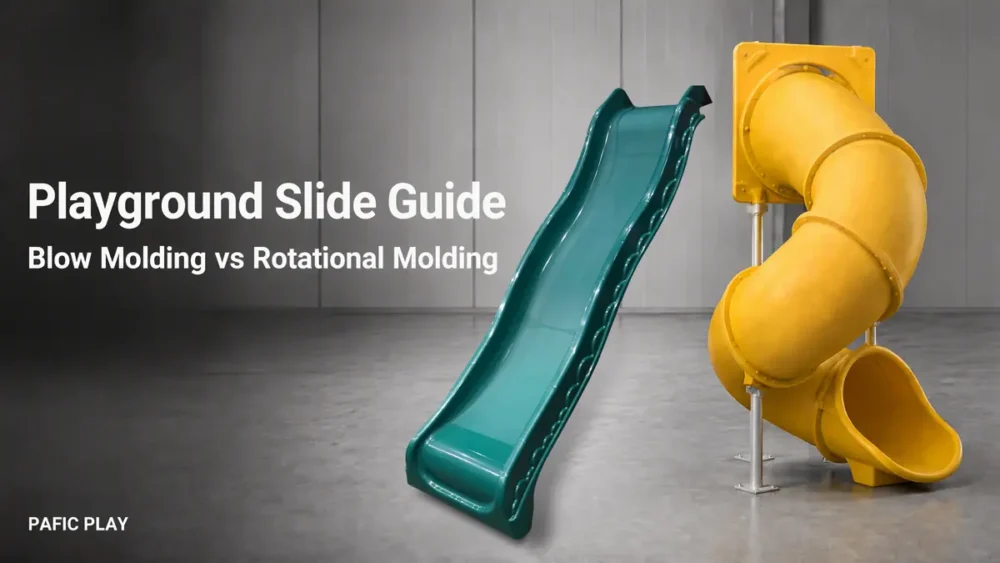
What do you look for when choosing a playground slide? Some people might say that as long as you pick one with a high safety rating, the kids will be safe. That’s right, safety is important. Here at PAFIC PLAY, safety has always been our top priority since we built our factory in 1997. But if you are buying in bulk, or you are building your own brand and putting your logo on the packaging, there are other things you also need to think about. Will the color fade after two summers? Will the slide bend when a heavier child sits near the bottom? Will it fit the deck height of the play equipment you already have?
We have had in-depth conversations with many buyers in the past. Some of them told us they had “paid a heavy price” before. Even though two slides looked exactly the same in the photos, they were very different in material, color and performance. The main reason for this difference is that the plastic was formed in a different way. Let’s take a closer look.
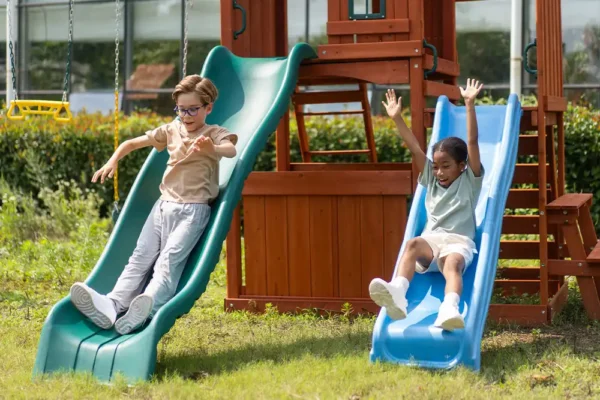
Two Manufacturing Processes for a Plastic Slide
Almost every plastic slide you see on a backyard slide set or in a small commercial play area is made from polyethylene (PE). The resin used is similar, but the manufacturing process is very different.
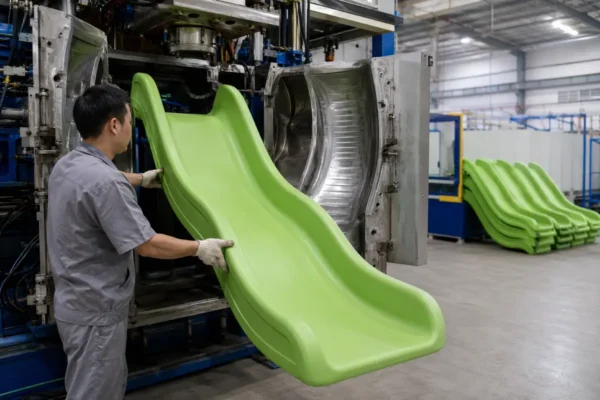
Blow Molding
In blow molding, a tube of melted high-density polyethylene (HDPE), called a “parison”, is placed between the two halves of a metal mold. The mold then closes, and air is blown inside, pushing the plastic against the inner walls of the mold. The result is a hollow, double-wall part.
For buyers, this means:
1).Short production cycle.Each part comes out of the machine quickly, so the unit cost goes down when the order volume is large.
2).High stiffness for its weight.The double-wall structure works like a “box beam” and helps keep a gently curved wave slide from bending.
3).Higher mold cost.Because blow molds have to withstand pressure, they cost more to make. This means the process only makes economic sense when the order volume is large enough.
4).Wall thickness may vary.In areas where the plastic stretches more, such as tight corners or deep edges, the walls can become thinner. A good factory keeps this under strict control, while a poorly managed factory often fails to check it.
Rotational Molding (Rotomolding)
In rotational molding, plastic powder is placed inside a hollow mold. The mold is heated while it slowly rotates on two axes, so the melted powder coats the inner walls of the mold evenly. It is then cooled, and a one-piece part is removed from the mold.
What this means for you:
1).More even wall thickness.Because there is no stretching during forming, corners and curved areas usually keep their wall thickness well.
2).Lower mold cost.Rotomolding is a low-pressure process, so the molds cost less to make. This is why it works very well for large or unusually shaped parts, such as tube slides and spiral slides, and also for small orders.
3).Longer production cycle.Each part takes longer to make, so in large-scale production its unit cost is usually higher than blow molding.
4).One-piece forming with no seams.For enclosed tube structures or curved parts, this is a clear advantage.
So, How Should You Choose?
In fact, neither process is completely “better” in every way. It depends on the type of product and your sales channel.
If you sell standard straight slides or wave slides for a swing set with slide, and your demand is high, blow molding usually gives you the best unit cost, and the product is strong and light, which makes it easy to ship.
If you need large tube slides, spiral slides or products with special shapes, and your order volume is small, rotomolding is often the better fit, because the mold investment is lower and it keeps the wall thickness even.
From our experience, the biggest risk is not choosing the “wrong” process. It is choosing a supplier that does not have good control over the process. No matter which process is used to make a slide, if the wall is too thin in key areas, it can crack easily.
Sun, Heat and Color: Outdoor Slide Issues Often Missed in a Quote
An outdoor slide is exposed to the sun all year round, and this leads to the two questions buyers ask us most often.
Fading and brittleness caused by UV light. Polyethylene breaks down under UV light unless UV stabilizers are added to the resin. If not enough stabilizer is added, the product will gradually fade, and the surface will become chalky and brittle. Always ask your supplier what type of UV additive they use, and ask for the resin technical data sheet. If they can’t give you a clear answer, that is your answer.
Surface temperature. Under direct summer sun, any slide can get very hot. Dark colors absorb heat more easily than light colors. If your products are sold in hot climates, light colors are the safer choice. We also suggest adding a simple note to the instruction manual, telling parents to check the slide surface temperature before their children use it. When installing the play equipment, it is also a good idea to point the slide away from the afternoon sun where possible.
Key Safety Details of a Playset Slide
The safety of a playset slide depends on its design details. When we review a slide design, we pay close attention to the following:
1).Side walls.The side walls must be high enough along the full length of the slide to keep children inside the sliding area at all times.
2).Entry and exit.The top of the slide should connect smoothly to the deck with no gaps. The exit should level out gradually, so children can slow down before they reach the ground.
3).No catch points.Any gaps, bolt heads or edges that could catch clothing or drawstrings must be removed, especially at the top of the slide.
4).Smooth edges.After trimming, there must be no sharp burrs on any molded edge or mounting hole.
When it comes to safety standards, ask for test reports that meet the requirements of your target market. For example, home playground equipment for the North American market should meet ASTM F1148, and public playground equipment should meet ASTM F1487. In Europe, the product should meet EN 71 or EN 1176, depending on the product type. If the slide is sold as part of a complete play set, make sure the test report covers the slide.
Fit and Hardware: Matching the Slide for Swing Set Use
A common problem we often see is a simple one: the slide does not match the deck height. Before you place an order, be sure to confirm the deck height of the play equipment the slide will be used with, and ask the factory to give you the slide’s designed deck height in writing.
You should also check:
1).Mounting brackets and bolts.The hardware should be corrosion-resistant, and the package should include enough parts.
2).Mounting points on the slide.These areas take the most stress. Ask the factory what reinforcement it uses.
3).Package size.A long one-piece slide takes up a lot of space in a carton and in a container. Get the package size as early as possible, so you can plan the loading and work out the freight cost per unit.
Working with PAFIC PLAY on Your Childrens Slide Project
If you are developing your own brand of swing sets, kids’ playhouses or a children’s playground slide range, we can support you all the way from design to packaging. We offer custom colors and brand logos, and we can design the packaging to suit your sales channel. Our factory operates under the ISO 9001 quality management system and has passed the BSCI social compliance audit. Send us your drawings, target market and deck height requirements, and our team will give you honest advice on which process best suits your product and order size.
FAQ:
What is the difference between a blow molded and a rotomolded playground slide?
A blow molded slide is made by blowing air into melted HDPE inside a mold, which creates a hollow double-wall part with a fast cycle time. A rotomolded slide is made by heating and rotating plastic powder inside a mold, which gives more even walls and suits large or complex shapes like tube slides.
Which plastic slide lasts longer outdoors?
Both can last well outdoors if the resin includes enough UV stabilizer and the wall thickness is properly controlled. The material quality and process control matter more than the process name.
How do I choose the right slide for a swing set?
Start with the deck height of the swing set, then confirm the slide’s design deck height, mounting hardware and side wall design. Ask for test reports for your target market before placing an order.
Do plastic slides get hot in the sun?
Yes, any slide in direct sun can get hot, and dark colors heat up more. Lighter colors and placing the slide out of the afternoon sun help reduce surface heat.