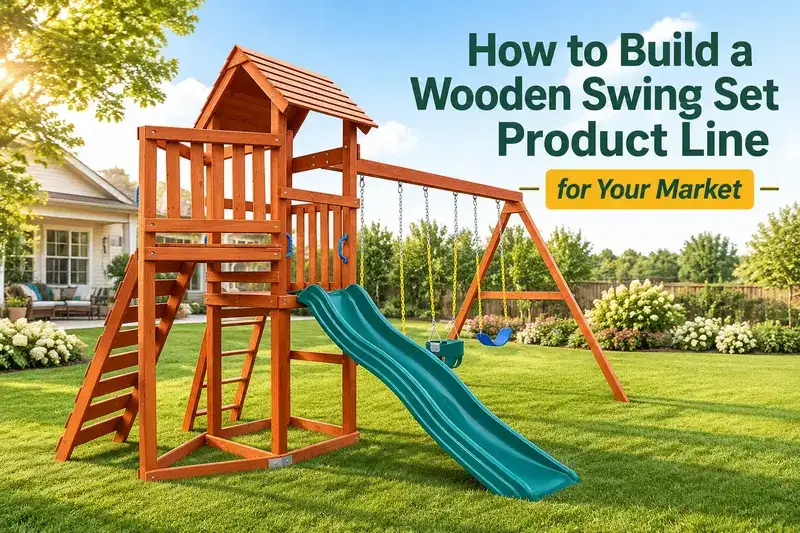
Launching a wooden swing set product line sounds straightforward, but it is rarely simple. When the first shipping container arrives, reality often presents tough challenges. From timber checking and cracking issues in dry climates, to oversized packaging that eats up freight space and shrinks margins, to strict safety standard audits—building a profitable wooden playset line takes far more than just picking a few attractive designs from a catalog.
Whether you are expanding an existing outdoor brand or developing an exclusive private-label collection for retail channels, success comes down to answering three practical questions: Which grade of timber fits your regional climate? What level of modularity should your product frames have? And how can you optimize carton volume without sacrificing structural strength?
In this guide, we will walk through how to build a wooden swing set product line that precisely matches your target market’s price points and safety expectations.
1. Build a “Good-Better-Best” Product Matrix
Start from Customer Needs
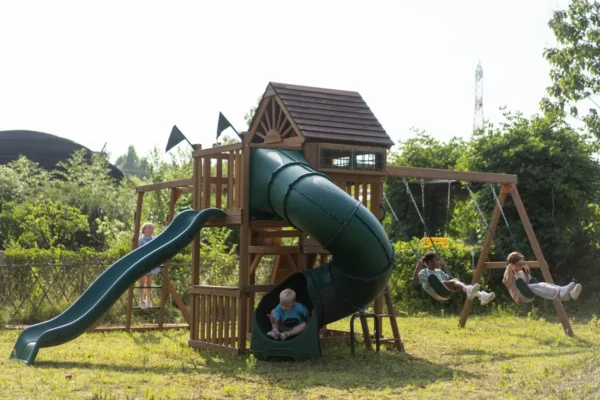
During early product planning, a wooden swing set lineup can take many different forms, offering buyers a wide variety of choices. Before finalizing colors or the number of accessories, first clarify the functional positioning of each model. For example, you can design a compact entry-level unit, a family playset with a slide, or a larger “clubhouse” model. When you first start building the product line, you do not need too many configurations—selecting two or three solid models that satisfy customer demands is often enough.
Write Brief Specifications for Each Product
Once products are selected, prepare a brief specification for each model, defining the target customer group, installation footprint, key features, sales strategy, and a realistic landed/retail price. Here is a practical tip: draw insights directly from real customer questions. For instance, if customers frequently ask whether the slide can be installed near a fence, providing a clear layout diagram can drive more sales than simply adding another color option.
Give Every Model a Clear Purpose
First, build a “hero product” tailored to your core customer segment. Then, ensure there are distinct, meaningful differences between your other models. For example, among PAFIC PLAY’s product lines:
- The “Hillside Play Centre“ integrates two plastic swing seats, a slide, and a rock climbing wall;
- The “Richmond Heights Playset“ builds on a wave slide, climbing wall, and double swing beam by adding a climbing net;
- The “Kensington Manor Playset“ delivers an entirely different experience with monkey bars, belt swings, ring/trapeze bars, a raised deck, and a balcony.
You can explore more of our products to see the unique features across different configurations.
Maximize Component Interchangeability Within Reason
Consult your wooden swing set manufacturer to confirm which components (such as swing seats, safety handles, hardware packs, or surface finishes) can be shared across the entire product lineup. Keep a documented record of these confirmed interchangeable parts by part number and model. Keep in mind that parts appearing identical in a catalog may differ in fastening methods, materials, or load applications.
Separate branding and colorway decisions from structural modifications. Before finalizing your product lineup, any changes involving swing beams, deck heights, or slide mounting brackets must be thoroughly reviewed with your manufacturer. They may need to update CAD drawings, produce new prototypes, and adjust required safety test scopes accordingly.
2. Select the Right Timber for Regional Climates
Wood is a natural, living material. The timber species you select must align with your target market’s climate conditions, pest risks, and retail price expectations:
Cedar (e.g., Cunninghamia lanceolata / Western Red Cedar)
- Key Features: Rich in natural oils, providing excellent natural resistance to rot, mold, and insect damage.
- Suitable Climates: Humid coastal regions and rainy climate zones.
- Manufacturing Notes: Cedar is prone to natural surface checking (minor longitudinal cracks that develop as moisture equalizes). While this does not affect structural integrity, it is essential to manage customer expectations through clear user manuals.
Nordic Spruce / Southern Yellow Pine (Treated)
- Key Features: High structural density with superior bending strength.
- Suitable Climates: High-load commercial or semi-commercial swing set frameworks.
- Manufacturing Notes: Must be pressure-treated with non-toxic, child-safe preservatives (such as ACQ or copper azole) that comply with EU REACH regulations and US CPSIA (Consumer Product Safety Improvement Act) chemical safety standards.
Factory Processing Standards
To prevent warping and deformation during ocean transit, the following standards should be followed:
- Moisture Content (MC): Timber must be kiln-dried before cutting and finishing, keeping moisture content tightly controlled between 12% and 14%.
- Surface Treatment: Finished at the factory with water-based, non-toxic wood stain containing UV inhibitors.
- Pre-Drilling and Labeling: All bolt holes should be pre-drilled, and each component must be stamped with part numbers to minimize end-user assembly complaints.
3. Packaging Engineering and Volume (CBM) Optimization
For imported wooden play equipment, shipping freight can account for up to 30%–45% of total landed cost. Therefore, maximizing shipping container space utilization through smart packaging engineering is vital to commercial viability.
- Modular Pre-Assembly: Pre-assemble labor-intensive subcomponents (such as ladder rungs, rock climbing panels, and window frames) in the factory, while shipping structural beams in flat-pack format.
- Carton Nesting: Design blow-molded or rotomolded slide components to nest neatly together, or wrap around long timber beams inside the cartons to conserve space.
- Standard Pallet Sizing: Ensure master cartons do not overhang the edges of standard pallets (US standard 40″ x 48″ or European standard 1200 x 800 mm) to prevent edge-crush damage during transit and cross-docking.
Frequently Asked Questions (FAQ)
Q1: What is the standard production lead time for custom wooden swing sets?
Once CAD drawings are approved, the standard OEM manufacturing lead time is typically 35 to 45 days. For seasonal inventory (Spring/Summer lines), retailers usually place orders between September and November to ensure delivery in the first quarter (Q1) ahead of the peak selling season.
Q2: How can we reduce return rates caused by natural wood checking and cracking?
Surface checking on outdoor timber is a natural phenomenon. We kiln-dry all lumber to maintain moisture content between 12% and 14%, and apply a protective sealant before packaging. In addition, including an illustrated “Wood Characteristics Guide” in the assembly manual helps consumers understand the difference between natural checking and actual structural defects.
Q3: Can we customize slide colors and swing accessories to match our brand palette?
Yes. Our rotational molding and injection molding workshops support custom Pantone color matching (subject to standard MOQ requirements) for slides, swing seats, climbing rocks, canopy fabrics, and other accessories.
Ready to Plan Your Next Season’s Outdoor Play Product Line?
Whether you need a complete private-label product catalog or want to optimize your current sourcing plan, feel free to contact the PAFIC PLAY OEM team. We can assist you in evaluating CAD designs, providing prototypes/samples, or planning a custom lineup tailored to your target market.